

Charlotte (39): "My son (10) had to redo his homemade school project because his teacher thought I had helped him with it"
A topic that hit close to home
My son Arjen is ten years old and is in Year 5. A few weeks ago, he came home and announced that he had to write a report. He was allowed to choose his own topic, as long as it was something he could find enough information about. I work as a nurse in the NICU, the intensive care unit for newborn babies. Of course, Arjen has known for years that I work there, but he had never asked in detail what exactly I do. I was delighted that he now wanted to learn more about it.
What's actually happening there?
That same evening, he started asking me questions. Why are some babies placed in an incubator? How small was the smallest baby I had ever cared for? Why do some babies have tubes in their noses? And why are parents sometimes not allowed to hold their baby right away? I could tell that he was genuinely interested. These were not questions he was asking just because he needed to quickly fill a few pages. He truly wanted to understand what happened in my ward. I told him about premature babies, respiratory support, and parents who sometimes spend weeks or months in the hospital. Arjen listened attentively, writing all sorts of things down in a notebook as I spoke.
He wanted to know everything
In the days that followed, he kept asking questions. At breakfast, he wanted to know how an incubator stayed warm, and on the way to soccer practice, he asked how nurses could tell whether a baby was getting enough oxygen. Sometimes I didn't immediately know how to explain something in simple terms. I'm used to talking with colleagues who use the same medical terminology, but of course you have to explain things differently to a ten-year-old. That was exactly what I enjoyed about it. I let Arjen try to explain difficult words himself and helped him whenever he didn't fully understand something. Little by little, it turned into a school project that he became incredibly enthusiastic about.
A look at my department
I asked at work whether I could bring Arjen in sometime to look at and photograph some of the equipment. They agreed, subject to clear conditions: it had to be at a quiet time, and no patients or family members could appear in the photos. Arjen was allowed to examine an unused feeding tube, hold a pulse oximeter, and take pictures of an incubator that was not in use. He also photographed tiny diapers, a baby hat, and various items we use when providing care. What impressed him most was the difference between regular baby items and the incredibly tiny ones on our ward.
A whole lot of photos
When we got home, Arjen had dozens of photos on my phone. He wanted to look at all of them and decide for himself which ones to use in his project. For each photo, he wrote down what it showed and what it was used for. Sometimes he would ask what a particular device was called. Then he would figure out for himself how to describe it in an understandable way. He even wanted to create a separate chapter about all the equipment. I suggested that he choose the most important things, because otherwise his project would become far too long. But Arjen thought the devices were actually the most interesting part.
His own words
We had agreed that Arjen would write the report himself. I was allowed to answer questions and explain things, but he had to put it in his own words. And he did. Sometimes he would read a passage aloud to me and ask whether it was correct. For example, if he wrote that an incubator ensures that a baby is always kept at exactly the same temperature, I would explain that it was a little more complicated than that. He would then revise the text himself. I thought that was a perfectly normal way to help. If a child is writing a report about volcanoes and his father is a geologist, surely his father should be allowed to explain things too? I genuinely could not see anything wrong with that.
An exceptionally comprehensive piece of work
Arjen turned out to be spending much more time on his project than I had expected. He created a table of contents, divided his text into chapters, and added a caption to every photo. He wrote about premature babies, incubators, feeding, and the role of parents in the ward. He also made a short glossary with terms such as NICU, oxygen saturation, and tube feeding. I thought it was quite comprehensive for a ten-year-old boy, but it was entirely his own choice. Some children enjoy spending hours working on a class presentation. Arjen now felt that way about this topic.
He was incredibly proud
On Sunday afternoon, we printed everything out, and Arjen put his project in a nice folder. He had worked on it for almost three weeks. As he leafed through it one last time, he said he hoped his teacher would find it interesting. I told him that, above all, I was proud of how much effort he had put into it. Of course, I thought it was special that he had chosen my work as his topic, but I was even prouder of the way he had immersed himself in it. He had learned a lot. In my opinion, that was exactly the point of a school project.
The first reaction
Two days after Arjen had handed in his project, he came home angry. I asked him how school had been, and he told me that his teacher had taken him aside. The teacher had said that his project looked very professional and contained a striking amount of medical information. He had then asked how much help Arjen had received from me. Arjen had explained that I worked in the NICU and had taught him a lot about it. According to Arjen, the teacher had then said that parents were of course allowed to help, but that the child still had to do the project themselves.
A message in the parent portal
However, the next morning I received a message from the teacher. He wrote that he had reviewed Arjen's project and that its content and presentation were strikingly above the usual level for Year 5. In particular, the medical terminology, the precise descriptions, and the photos of professional equipment had made him question how much of it Arjen had done independently. He therefore wanted to discuss with me where the line should be drawn between parental support and doing a child's schoolwork for them. I read the message twice. The wording was polite, but the message seemed quite clear to me. He thought I had done most of the project.
What did he base that on?
What bothered me most was that the teacher had apparently drawn conclusions without knowing how the project had been put together. Of course it contained medical terms. After all, the subject was a hospital ward where specialized care was provided. And of course Arjen had photos of professional equipment. I worked there and had helped him view those materials in a safe and authorized way. That may have made his project different from a classmate’s project about soccer or dogs, but surely it did not automatically mean that he had not made it himself? I wondered why a detailed project was suddenly considered suspicious.
I already had a hard time with him
Maybe I reacted so strongly because I had never really connected well with this teacher. From the beginning of the school year, I found him rather strict and sometimes a bit curt in the way he communicated. During the first parent-teacher conference, for example, he had said that Arjen could stand to be a little more independent, whereas I felt that he already took on a lot of responsibility at home. On another occasion, he had responded rather dismissively when Arjen said that he felt excluded during a group assignment. None of these were major incidents, but taken together, they made me feel uneasy whenever I spoke with him. Now, once again, I felt that he was mainly looking for problems.
I sent a response
I wrote back that I would be happy to explain how Arjen had obtained his information. I said that he had interviewed me, selected the photos himself, and written all the text independently. I also explained that I had checked certain medical information because I felt it was important that he not write anything inaccurate. In addition, I had helped him obtain permission to photograph demonstration materials. I asked the teacher which specific parts had led him to suspect that I had taken over the project. I was quite willing to discuss the guidance I had provided, but not on the basis of an unfounded suspicion.
An invitation to a conversation
The teacher replied that he would appreciate it if I stopped by after school. He preferred to explain his concerns in person. I agreed, although I could tell that I was quite annoyed about it. I had a busy workweek and was not looking forward to a conversation in which I would have to prove that I had not done my son's homework. At the same time, I felt that Arjen deserved a fair assessment. He had worked on it for weeks, and I did not want his efforts to be valued less simply because I happened to know a lot about the subject.
A conversation I was dreading
The following afternoon, I walked to his classroom after school. I had resolved to remain calm. Even so, I felt a surge of irritation when I saw him sitting behind his desk with Arjen’s project in front of him. He opened the folder to the chapter on respiratory support and pointed to a few sentences. In his view, they were remarkably well phrased for a ten-year-old. Then he showed me a photograph labeling the various parts of an incubator. He asked whether I truly expected him to believe that Arjen had done all of this on his own. At that moment, I knew this was not going to be an ordinary conversation about parental help.
I felt accused
I looked at the report lying on the table between us and asked the teacher what exactly he meant. He said he found it hard to imagine that a ten-year-old student could independently process such detailed information about medical equipment. He was particularly struck by the combination of professional photographs and precise descriptions. I replied that Arjen had in fact spent a great deal of time trying to understand those devices. He had asked me questions, looked up information, and then written down what he had learned in his own words. Surely the fact that I had explained things to him did not automatically make me the author of his report? I was a source he could consult.
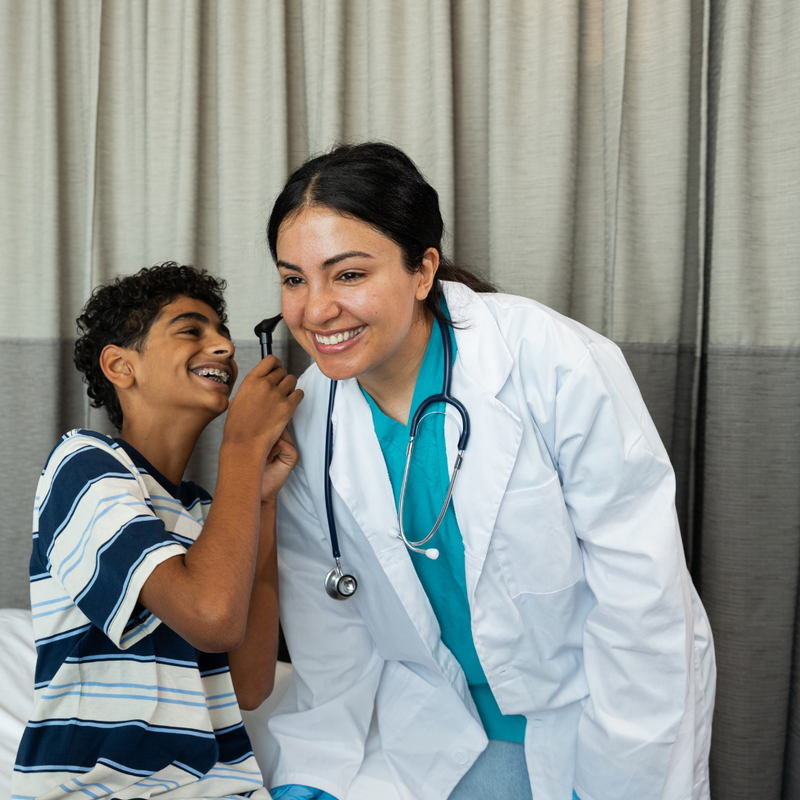
Why wouldn't he be able to do this?
The teacher said that he knew Arjen as a boy who often wrote fairly short pieces for regular writing assignments. His essays usually consisted of just a few paragraphs, and he frequently needed encouragement to write in greater detail. This project, by contrast, was twelve pages long, including photographs and a glossary. That difference had made him wonder. I finally understood where his doubts came from. Still, I thought it was rather simplistic to compare the length of a project with an essay on some random topic. Arjen was personally invested in this and had worked on it voluntarily for weeks.
A child can surprise you
I explained that Arjen does not always feel like writing at home either. If he finds an assignment boring, he wants to get it over with as quickly as possible. But as soon as something captures his interest, he can spend hours on it. That applies to building, drawing, and apparently also to a project about my work. I actually thought it was wonderful that, for once, he was showing how much he could do when he was enthusiastic about something. The teacher said he understood, but that he still needed to be able to assess what Arjen had done independently. I agreed with him. I just felt that he should ask Arjen that question instead of immediately looking to me.
It concerned the assessment
When I asked whether he intended to deduct points, the teacher said that he had postponed the assessment for the time being. He first wanted clarification about the extent of parental support. I thought that was quite a drastic decision. Arjen had submitted his project on time and met all the requirements. There had been no stipulation that the children were not allowed to interview their parents or receive help gathering information. The teacher acknowledged that such a rule had indeed not been explicitly stated in the assignment. However, he felt it should go without saying that students were expected to do their work independently. I replied that Arjen had done so.
A proposal from my side
I suggested that the teacher ask Arjen a few questions about his project. Not as a kind of interrogation, but simply to find out what he knew. For example, he could ask him why some babies are placed in an incubator, what an oxygen saturation monitor measures, or how tube feeding works. Arjen had researched those topics himself and would have no trouble explaining them. The teacher thought that was a reasonable suggestion. He said he would speak briefly with Arjen the next day and then give a final assessment. I was relieved that something concrete had finally been agreed upon.
No excuses
What I did find disappointing was that the teacher never once said that he might have judged too quickly. He kept emphasizing that, as a teacher, he had to take a critical look at assignments that deviated noticeably from the usual standard. I understood his responsibility, but I felt that he also needed to realize what his doubts could do to a child. By then, Arjen was afraid that he had done something wrong. The teacher said that, of course, that had not been his intention. Even so, he had asked my son several times how much help he had received, without making it clear what exactly was going on.
Arjen was nervous
When I told Arjen at home that the teacher would ask him a few questions the next day, he became nervous. He asked whether he had to know everything by heart and whether he was going to have some kind of test again. I explained that the teacher only wanted to hear what he had learned. Arjen immediately picked up his project and started reading through it. I told him that really wasn't necessary. He had worked on it for so long that he definitely knew the most important things. But he wanted to make sure he wouldn't make any mistakes. I felt sorry that an assignment he had been so proud of was suddenly causing him so much anxiety.
The Master's Questions
The following afternoon, Arjen came home and said that the interview had gone well. The teacher had asked him all sorts of questions, and Arjen had answered them in detail. He even said that he had explained how important skin-to-skin contact can be and why parents are sometimes encouraged to practice kangaroo care with their baby. According to him, the teacher had said that he clearly knew a great deal about the subject. Arjen sounded relieved, but he still wondered whether he would get a good grade.
Finally, a grade
Two days later, he got his project back. There was a 9 on the front. The teacher had written that it was a very thorough and informative project, with beautiful photos and a clear structure. He had also written that Arjen had clearly demonstrated his understanding of the subject. Of course, I was pleased with the grade. But as I leafed through the project, I realized that I still had an uneasy feeling. Why had there first been so much doubt before his efforts were recognized? I felt that the teacher had every right to be critical, but that he could have discussed his suspicions more carefully.
My husband thought it had been resolved.
My husband thought we should leave it at that. Arjen had received a 9, the teacher had established that he understood his project, and no points had been deducted. In his view, that meant the problem was resolved. I understood what he meant, but by then, for me, it was no longer just about the grade. I felt it was important how a teacher treats a child when they have doubts about something. Of course, it is fine to ask questions and check whether the work was done independently. But I believe you should be careful with suspicions, especially when they make a child feel accused.
Helping is not the same as taking over
I think there is an important difference between doing your child’s school project for them and helping your child learn something. I didn’t give Arjen any ready-made text. I explained what my work involves, answered questions, and checked whether the medical information was accurate. He decided for himself what he wanted to use and how he wanted to write it up. That seems to me to be exactly what an interview with an expert should be. If he had interviewed his grandfather about the Second World War, no one would find it strange that he learned things that were not stated word for word in a children’s book. Why should my work be any different?
What he learned from it
As far as I was concerned, the most important outcome was not that grade, but everything Arjen had learned while working on it. He now has a better understanding of why I sometimes work night shifts and why I can be tired or quiet after a shift. He knows that the NICU not only cares for babies, but also devotes a great deal of attention to parents going through a stressful time. He has learned to ask questions, organize information, and explain difficult topics in his own words. He has also discovered how enjoyable it can be to really delve into a subject.
My opinion of the teacher
I'll be honest: the teacher is still not my favorite. We have different ways of communicating, and I sometimes find him unnecessarily strict. I also don't think he deliberately tried to make Arjen feel bad. He probably just wanted to make sure he was grading fairly. Still, I think this situation shows how important it is to be careful about making assumptions. A child can be affected by them much more than an adult realizes.
Proud of his project
The project about the NICU is now kept in a cabinet in the living room. Arjen did not want to throw it away, and neither did I, really. Every now and then, he still takes it out to show a photo when we have visitors. He then talks enthusiastically about a piece of equipment or explains how tiny some premature babies can be. At moments like those, I can see exactly why he chose this topic. Not because I wanted him to make an impressive project, but because he was curious about my work and wanted to tell others about it in his own way. I hope his teacher eventually saw that too. Because when a child does more than you expect, I believe what they deserve first and foremost is interest—not immediate suspicion.